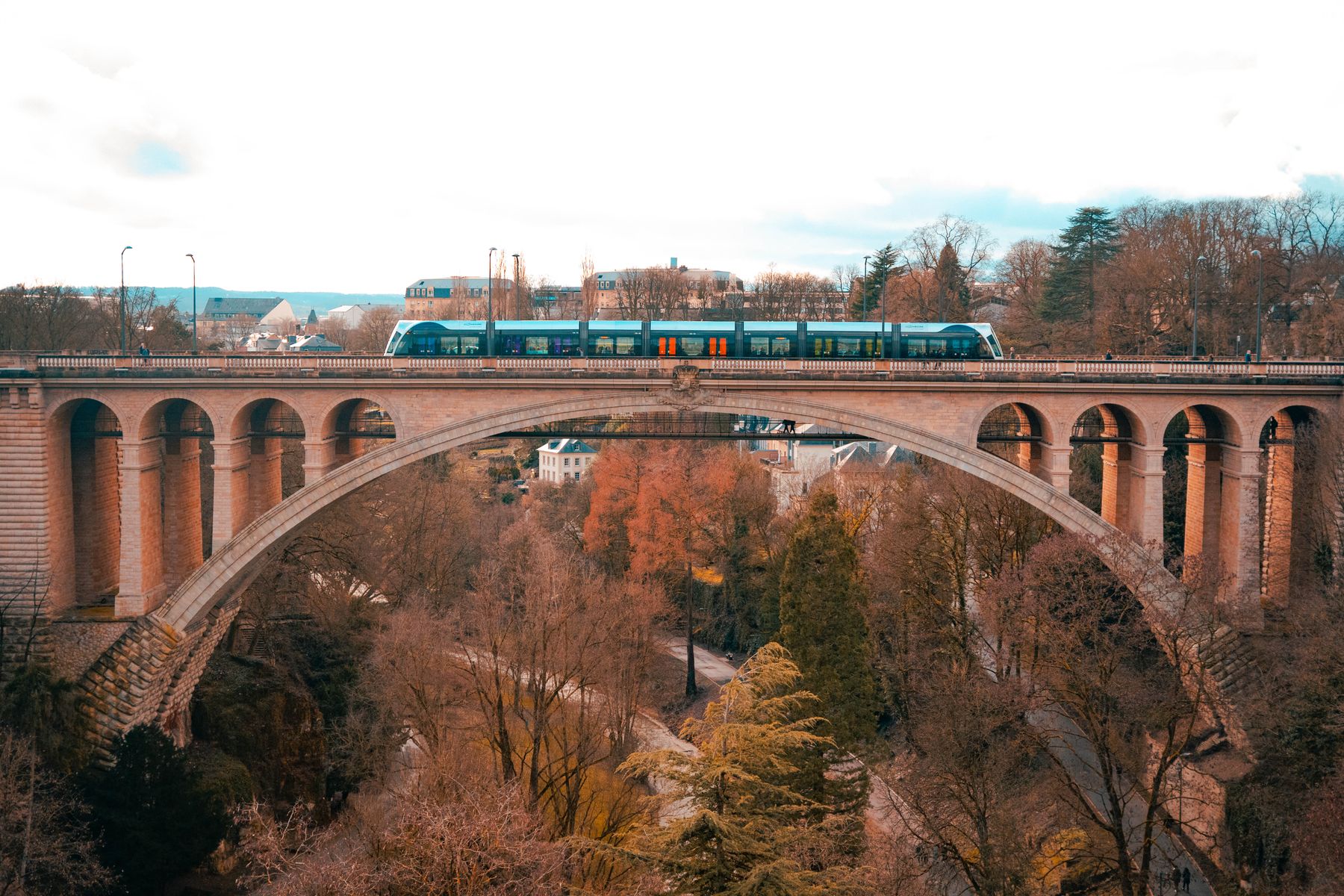
Why the bus network is the practical way out of the capital
Luxembourg has no domestic flight network worth considering, and the train map thins out quickly once you leave the main line. Buses fill the gaps: almost every village in the Grand Duchy is served at least a few times a day, and the regional express coaches run from the Gare Centrale forecourt and from the Kirchberg P+R. Free public transport applies nationwide, so a day trip to Echternach or Clervaux costs nothing in fares — you only pay for food, entry tickets and whatever you bring home. The catch is frequency, not money.
Treat the bus as a scheduled commitment rather than a hop-on service. On the trunk routes — line 110 toward Echternach, the 570 corridor to Clervaux via Ettelbruck, the 947/948 connections that feed the Mullerthal — you get a workable hourly or half-hourly rhythm on weekdays that thins to roughly two-hourly on Sundays. Outside those corridors, a village might see four departures a day. Check the mobiliteit.lu journey planner the evening before, and note the last return: missing it is the one mistake that genuinely strands you.
Echternach and the Mullerthal: the easiest first outing
Line 110 leaves Luxembourg City and reaches Echternach in about 50 minutes via Junglinster and Consdorf, dropping you a short walk from the basilica and the market square. Echternach itself is small — the abbey, the Roman villa site and the lake at the north edge will occupy a morning — but the real draw is the surrounding Mullerthal, Luxembourg's sandstone hill country. Marked trails leave from the town and from Berdorf, four kilometres east, where the rock formations around Huel Lee and the Amphitheatre are the densest and most photographed.
Book a hotel in Echternach rather than day-tripping twice. Staying here puts the Mullerthal trails at your doorstep before the first coach of walkers arrives around ten, and the town empties out in the evening in a way the capital never does. April to June and September to early October give the best walking weather; July and August are busier and warmer, and the woods hold the heat. Bring footwear with grip — the sandstone paths are slippery after rain, and rain here is common in any month.
Vianden, Clervaux and the Ardennes north
Vianden sits in a sharp river gorge on the Our, and the castle above it is the reason most people come. From Luxembourg City you take the train to Ettelbruck (about 30 minutes) and connect to the 570 or 571 bus for the final 25-minute climb along the valley; there is also a direct coach from the capital that takes around 75 minutes but runs less often. The castle takes two to three hours properly, the chairlift opposite gives the classic view back across the rooftops, and Victor Hugo's house on the main street is a short, worthwhile stop.
Clervaux is 25 minutes further north by bus from Ettelbruck and worth a night rather than an afternoon. The Benedictine abbey dominates the town, the photographic exhibition of Edward Steichen's Family of Man is housed in the castle, and the surrounding plateau country opens out into the Ardennes. Note the season: Vianden's castle and Clervaux's museum run reduced winter hours from roughly November to March, and some valley restaurants close entirely in January and February. My preference for a two-night northern stay is Clervaux — quieter, better placed for walks, and a genuine town rather than a tourist funnel.
Tickets, timing and what to skip
Nothing on the bus network requires a ticket purchase, but you may be asked to show a pass or ID by a controller; carry identification as a matter of habit. Standard coaches have luggage space underneath on the longer regional runs, and bicycles travel only on marked routes in the Mullerthal and along the Chiggeri valley paths, not on the express coaches. Seats fill on Friday afternoons and on the first sunny weekend of spring, when walkers head for Berdorf en masse.
Skip the temptation to string three destinations into one day. Echternach plus Vianden is technically possible via Ettelbruck but eats most of your daylight in transit and leaves you rushing both. Pick one area per day, and if you want two, sleep between them. The other thing to skip is the car-hire reflex: parking in Echternach and Vianden is tight in high season, and the bus drops you closer to the old centres than any car park does. Base yourself in the capital for city days and move out for the rest.
Connections, comfort and the return leg
The Gare Centrale forecourt is the main departure point, with stands grouped by direction rather than by line number, so read the screens rather than the pole. Coaches toward the north leave from the Rue de la Gare side, those for the east from the central island. On weekdays the 110 and the Ettelbruck corridor both run through the morning peak, which means you may stand for the first twenty minutes before seats free up past Junglinster or Mersch. Allow ten minutes of buffer at the station.
The return leg deserves as much planning as the outbound. Sunday evening coaches back to the capital are the busiest of the week, filled with students and weekenders, and the last departure from Echternach or Clervaux often leaves before eight in the evening. If your day runs long, the train from Ettelbruck to Luxembourg City runs late and is a reliable fallback for the northern routes; for the Mullerthal there is no rail option, so set an alarm for the penultimate bus rather than the last.
Where to base yourself and what to skip
For a three-day countryside trip, split the stay: two nights in Echternach for the Mullerthal, one in Clervaux for the Ardennes, and the capital at either end. Hotels in Echternach cluster within the old walls near the basilica, while Clervaux's are strung along the main road and the station approach. Vianden has the most atmospheric setting but the fewest beds and the steepest streets; it suits a single night or a long afternoon rather than a base for walking further afield.
Skip the notion that a car gives you freedom here. The valley roads around Vianden and the lanes into Berdorf are narrow and busy in summer, and the bus stops are closer to the trailheads than most car parks. What a car does buy you is timing — useful only if you want to combine two distant villages in one day, which rarely works well. Otherwise, rely on the schedule, carry water, and let the timetable decide your pace.
Related articles
Hotels in Echternach
Questions, answered
Do I need to buy a bus ticket in Luxembourg?
No. Public transport, including regional buses and trains, is free throughout Luxembourg for residents and visitors. You may be asked to show identification by a controller, so carry your passport or ID card with you.
How long does the bus take from Luxembourg City to Echternach?
Roughly 50 minutes on line 110, depending on traffic through Junglinster and Consdorf. Buses run about hourly on weekdays and less frequently on Sundays, so check the last return before you set out.
What is the best way to reach Vianden without a car?
Take the train from Luxembourg City to Ettelbruck, around 30 minutes, then the 570 or 571 bus up the valley, about 25 minutes more. A less frequent direct coach also runs from the capital in roughly 75 minutes.
Are the buses reliable on Sundays and public holidays?
Service is reduced rather than absent. Expect roughly two-hourly frequencies on main corridors and very sparse service to smaller villages. Plan around one or two fixed departures rather than assuming you can turn up and go.
Which month is best for the Mullerthal trails?
Late April to June and September into early October give the most comfortable walking conditions. July and August are warmer and busier, and the sandstone paths are slippery after rain in any season, so bring shoes with proper grip.
Can I reach Clervaux and Vianden in a single day?
It is possible via Ettelbruck but not enjoyable. The connections cost you most of the daylight and leave too little time at either castle. Choose one, or stay a night in Clervaux and visit the other the following morning.
Where should I stay for a countryside-focused trip?
Echternach suits walkers in the Mullerthal, while Clervaux is better placed for the northern Ardennes and makes a calmer base than Vianden. Keep a hotel in Luxembourg City for the days you want the capital.
Is there luggage space on the regional coaches?
Yes on the longer regional routes, where luggage goes in the compartment underneath. Bicycles are only carried on designated routes in the Mullerthal area, and not on the express coaches, so check before travelling with a bike.
Doing good is the business: every booking through Stay Luxembourg funds one verified tonne of carbon removal — same room, same price, no markup.
Start Your Search